Exercise 12C
Q1 | Ex-12C |Class 8 |Mensuration | S.Chand | New Learning | Composite mathematics | myhelper
Question 1
Find the surface area and lateral area of each cuboid / cube. All lengths are in centimetres.
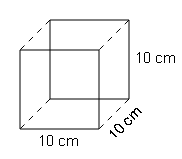
(a)
Surface Area=6×(side)2
=6×(10)2
=6×100=600unit2
Lateral Area=4×(side)2
=4×(10)2
=4×100
=400 unit2
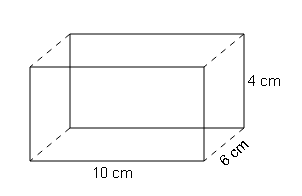
(b)
S.A=2(l×b + b×h + h×l)
=2(10×6 + 6×4 + 4×10)
=2(60+24+40)
=2×124
=248cm2
L.A=2h(l+b)
=2×4×(10+6)
=8×(16)
=128cm2
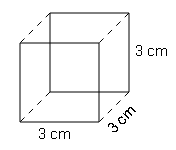
(c)
S.A=6×(side)2
=6×(3)2
=6×9
=54cm2
L.A=4×(side)2
=4×(3)2
=4×9
=36cm2
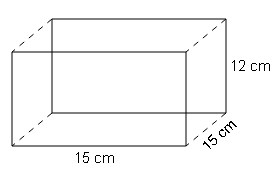
(d)
S.A=2(l×b + b×h + h×l)
=2(15×15 + 15×12 + 12×15)
=2(225+180+180)
=2×585
=1170 cm2
L.A=2h(l+b)
=2×12(15+15)
=2×12×30
=720 cm2
(e)
Sol :
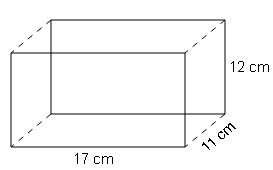
S.A=2(l×b + b×h + h×l)
=2(17×11+11×12 +12×17)
=2×(187+132+204)
=2×(523)
=1046 cm2
L.A=2h(l+b)
=2×12×(17+11)
=24×28
=672 cm2
(f)
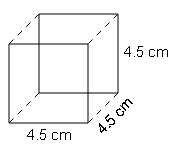
S.A=6×(side)2
=6×(4.5)2
=6×20.25
=121.50 cm2
L.A=4×(side)2
=4×(4.5)2
=4×20.25
=81 cm2
Q2 | Ex-12C |Class 8 |Mensuration | S.Chand | New Learning | Composite mathematics | myhelper
Question 2
Find the surface area of a cuboid, given
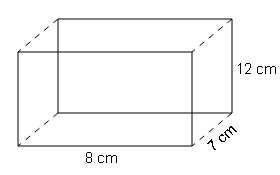
(a) Length=8 cm, Breadth=7 cm, Height=12 cm
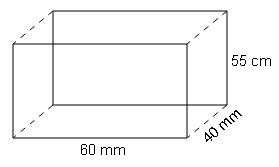
(b) Length=60 mm, Breadth=40 mm, Height=55 mm
Sol :
(a)
L=8cm , B=7cm, H=12cm
∴S.A={2(8×7)}+{2(7×12)}+{2(8×12)}
=(2×56)+(2×84)+(2×96)
=112+168+192=472cm2
(b)
L=60cm , B=40cm , H=55cm
∴S.A={2(60×55)}+{2(40×55)}+{2(60×40)}
=(2×3300)+(2×2500)+(2×2400)
=6600+4800+4800=15800cm2
Q3 | Ex-12C |Class 8 |Mensuration | S.Chand | New Learning | Composite mathematics | myhelper
Question 3
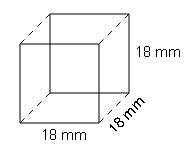
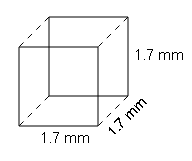
Find the surface area of a cube with side length
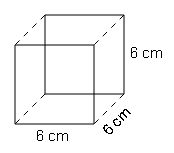
(a) 6 cm
S.A={2(6×6)}+{2(6×6)}+{2(6×6)}
=(2×36)+(2×36)+(2×36)
=72+72+72=216cm2
(b)
=(2×324)+(2×324)+(2×324)
=648+648+648=1944cm2
(c)
S.A={2(1.7×1.7)}+{2(1.7×1.7)}+{2(1.7×1.7)}
=(2×2.89)+(2×2.89)+(2×2.89)
=5.78+5.78+5.78=17.34cm2
Q4 | Ex-12C |Class 8 |Mensuration | S.Chand | New Learning | Composite mathematics | myhelper
Question 4
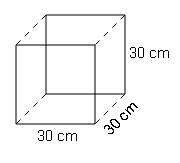
Find the surface area of a wooden cube of side length 30cm
Sol :
Cube side=30cm
S.A={2(30×30)}+{2(30×30)}+{2(30×30)}
=(2×900)+(2×900)+(2×900)
=1800+1800+1800=5400cm2
Q5 | Ex-12C |Class 8 |Mensuration | S.Chand | New Learning | Composite mathematics | myhelper
Question 5
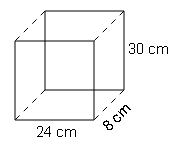
A cornflakes box measures 30 cm by 24 cm by 8 cm. Calculate the surface area of the box
Sol :
L=24cm, B=8cm ,H=30cm
S.A={2(24×8)}+{2(24×30)}+{2(30×8)}
={2×192}+{2×720}+{2×240}
=384+1440+480=2304cm2
Q6 | Ex-12C |Class 8 |Mensuration | S.Chand | New Learning | Composite mathematics | myhelper
Question 6
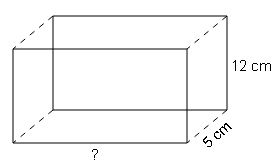
Find the missing dimension in the figure with the given surface area.
Sol :
B=5cm ,H=12cm ,L=?
S.A={2(x×5)}+{2(x×12)}+{2(5×12)}
={5x×2}+{24x}+{2×60}
=10x+24x+120=3x+120
ATQ,
S.A=256=34x+120
34x=256-120=136
$x=\frac{136}{34}$=4cm
Q7 | Ex-12C |Class 8 |Mensuration | S.Chand | New Learning | Composite mathematics | myhelper
Question 7
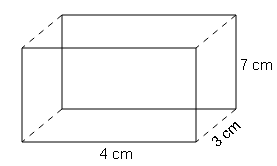
A cuboid is 3 cm by 4 cm by 7 cm. Explain whether doubling all of the dimensions would double the surface area?
Sol :
L=4cm, B=3cm ,H=7cm
S.A1={2(4×3)}+{2(4×7)}+{2(3×7)}
={2×12}+{2×28}+{2×21}
=24+56+42=122cm2
If doubling all of dimensions
∴L=4×2=8cm ,B=3×2=6cm ,H=7×2=14cm
∴S.A2={2(8×6)}+{2(6×14)}+{2(8×14)}
=(2×48)+(2×84)+(2×112)
=96+168+224=488
∴S.A2=488
S.A1=122
∴S.A2=122×4=S.A1×4
∴No, It will be 4 times
Q8 | Ex-12C |Class 8 |Mensuration | S.Chand | New Learning | Composite mathematics | myhelper
Question 8
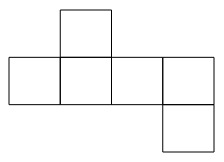
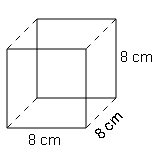
The net consists of 6 equal squares with side length 8 cm
(a) Name the solid it represents.
(b) Find the surface ares of the solid.
Sol :
(a) The solid shape is cube
(b) S.A={2(8×8)}+{2(8×8)}+{2(8×8)}
={2×64}+{2×64}+{2×64}=128+128+128=384cm2
Q9 | Ex-12C |Class 8 |Mensuration | S.Chand | New Learning | Composite mathematics | myhelper
Question 9
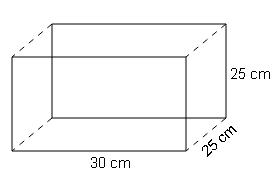
A small indoor greenhouse (herbarium) is made entirely of glass panes (including base) held together with tape. It is 30 cm long. 25 cm wide and 25 cm high.
(a) What is the area of glass?
(b) How much tape is needed for all the 12 edges?
Sol :
(a)
S.A.={2(30×25)}+{2(30×25)}+{2(25×25)}
=(2×750)+(2×750)+(2×625)
=1500+1500+1250=4250cm2
(b)
Length of top for all 12 edges=Perimeter of the top+Four vertical edge
={2(30+25)}+{25×4}
=(2×55)+(100)
=110+100=210cm
Q10 | Ex-12C |Class 8 |Mensuration | S.Chand | New Learning | Composite mathematics | myhelper
Question 10
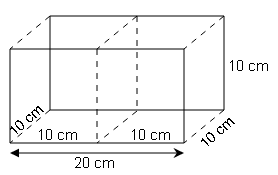
Two cubes each of 10 cm edge are joined end to end. Find the surface area of the resulting cuboid.
Sol :
S.A={2(20×10)}+{2(20×10)}+{2(10×10)}
=(2×200)+(2×200)+(2×100)
=400+400+200=1000cm2
Q11 | Ex-12C |Class 8 |Mensuration | S.Chand | New Learning | Composite mathematics | myhelper
Question 11
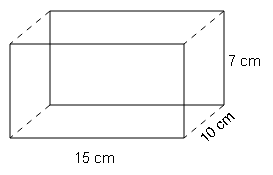
Daniel is painting the walls and ceiling of a cuboidal hall with length, breadth and height of is 15 m, 10 m and 7 m respectively. From each can of paint, $100 \mathrm{~m}^{2}$ of area is painted. Hone many cans of paint will he need to paint the entire room?
Sol :
S.A={2(15×7)}+{2(10×7)}+{2(15×10)}
=(107×2)+(70×2)+(150)
=210+140+150=500cm2
∴Cans of paint needed$=\frac{500}{100}=5$
Q12 | Ex-12C |Class 8 |Mensuration | S.Chand | New Learning | Composite mathematics | myhelper
Question 12
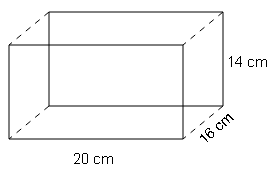
A cuboidal tin box opened at the top has dimensions 20cm×16cm×14cm. What is the total area of metal duct sheet required to make 10 such boxes?
Sol :
S.A=2(l×b + b×h + h×l)
=2(20×16+16×14+14×20)
=2×(320+224+280)
=2×824
=1648 cm2
∴1 box need 1648 cm2 sheet
∴10 box need 1648×10=16480cm2 sheet
Q13 | Ex-12C |Class 8 |Mensuration | S.Chand | New Learning | Composite mathematics | myhelper
Question 13
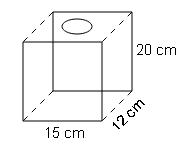
Find the area to be painted in the given block with a cylindrical hole. Given that length is 15 cm, width is 12 cm, height is 20 cm and radius of the holes is 2.8 cm.
Sol :
S.A=2(l×b + b×h + h×l)
=2(15×12 + 12×20 + 20×15)
=2(180+240+300)
=2×720
=1440 cm2
∴Area of hole=πr2
$=\frac{22}{7}\times (2.8)^2$
$=\frac{22}{7}\times \frac{28}{10}\times \frac{28}{10}$
$=\frac{2464}{100}$
=24.64
∴Area to be painted=Total surface of the block-(2×Area of one circular hole)
=1440-(24.64×2)
=1440-49.28
=1390.72cm2
Q14 | Ex-12C |Class 8 |Mensuration | S.Chand | New Learning | Composite mathematics | myhelper
Question 14
The area of the four walls in a room is $120 \mathrm{~m}^{2}$. The length is twice the breadth. If the height of the room is 4m , find the area of the floor.
Sol :
Let breadth of room =x m
Length of room =2x m
Height of the rm=4 m
The area of the four walls=2(bh+lh)=120
2(x×4+2x×4)=120
2(12x)=120
$x=\frac{120}{4}$=5 m
Breadth=x=5 m ,
Length=2x=2×5=10 m
Area of floor=l×b=10×5=50 m2
Q15 | Ex-12C |Class 8 |Mensuration | S.Chand | New Learning | Composite mathematics | myhelper
Question 15
A cube of edge 5 cm is cut into cubes, each of edge 1 cm. Find the ratio of the total surface area of one of small cubes to that of the large cube.
Sol :
Edge of large cube =5 cm
Area of large cube $=6(a)^{2}=6 \times(5)^{2}$
=6×25=150 cm2
Edge of small cube=1 cm
Area of small cube$=6 \times(a)^{2}=6 \times(1)^{2}$
Area of small cube : Area of large cube $=\frac{6}{150}=\frac{1}{25}$
1 : 25